
We are excited to announce Fieldline 4.2, featuring offline near-miss reporting for site teams. Learn more on our website.
40 comments
Employee Content for B2B teams
Buyers scroll past company pages and reply to people. One recorded interview a month becomes LinkedIn and X posts for each person on the programme, written for their role and approved by them. Comments are prepared for each person to send from their own account, and each conversation is logged in your CRM.
Free 30-minute call · No pitch deck · Written recommendation after
Fixed-scope pilot. Fixed price agreed on the call.

Muneeb built my LinkedIn and my sales team’s profiles from scratch. Within a few months we were having conversations we never had before.Ben Gardner · Founder, Navitas Safety
We are excited to announce Fieldline 4.2, featuring offline near-miss reporting for site teams. Learn more on our website.
We rebuilt the near-miss form so it works with no signal.
Site teams were writing reports on paper and typing them up later, or not at all. The new form has three fields and syncs when the phone finds a connection.
…more
Every first call, the same question: “Will my supervisors actually use it?” We stopped answering with a demo. One site, thirty days, then we read the numbers together.
New messageExample Priya ShahVP Operations · NorthwindCould your team show our regional leads on Thursday? Target account · logged in HubSpot Why employee accounts
A company page reads as advertising. The same subject from the engineer who built the feature, or the account manager who ran the rollout, reads as experience, and buyers respond to it.
74%
trust “someone like me” to tell the truth about new innovations and technologies. A company technical expert scores 66%, and CEOs 51%.
2.60%
average engagement rate for personal LinkedIn profiles, against 1.60% for company pages, across 673,658 posts. Impressions per post were similar for both.
252%
increase in click-through rate when a company promotes its people’s posts as Thought Leader Ads, compared with conventional single-image ads.
The work is to give each person something specific to say every week without taking their time.
How it works
Each person gives one interview a month and a few minutes a day to approve drafts and send the comments prepared for them. The writing, scheduling and message sorting are done for them.
Stage one
Two or three people join a 45-minute call each month. The recording is transcribed, and the strongest statements are marked against the person who made them.
 Interview recorded · 46 min · transcript cleaned and marked by speaker
Stage two
The subject is divided by what each person knows first-hand. Drafts reach each person in a private Slack message, where they approve, edit or skip them.
ApprovedEdited, approvedWaitingApprovedStage three
Approved posts are scheduled across the week so the team is present every working day. Longer posts go to LinkedIn, shorter posts and threads to X, and the clearest moments of the interview are cut into captioned clips.
Bought at head office, abandoned on siteReporting drops after month oneSarah on site adoption · 0:42 Marcus HaleHead of Sales “Will my supervisors use it?”One site, thirty days Tomás ReyesStaff Engineer Thread: the form that works offlineRebuilding the near-miss form Imani ClarkeCustomer Success Lead Imani on week two · 0:36The first 30 days on siteReply to every early report LinkedIn postX post or threadShort clipStage four
Each person receives a short daily list of posts from buyers and peers in their field, with a suggested comment, and sends it from their own account. Connection requests and messages are sorted within a working day, and warm conversations are passed to the person or to sales.
Three audits this quarter. The paperwork took longer than the fixes.
Messages and requestsStage five
A conversation that starts from a post, a comment or a message is logged against the account in HubSpot or Zoho, with the person and the post that started it. The monthly report counts conversations and meetings for each person.
LinkedIn · Employee ContentActivity
Commented on Tomás Reyes’s post, “The near-miss form that works with no signal”Marcus Hale commented on her post about audit paperworkSent a message to Marcus Hale Meeting booked with regional leads
The next section follows one interview through each person’s account.
Example feeds
Fieldline is an example company that sells incident-reporting software. Each person below posts on the part of the subject they know first-hand, and the conversations that follow are recorded.
Source interview · 12 November · “Why near-miss reporting stops after the first month”Example company and peopleLinkedIn · opinion post
Most safety software is bought at head office and abandoned on site.
We see the same pattern in almost every rollout. Reporting is high in the first month and falls once the launch push ends.
The software is rarely the cause. A supervisor with twelve people and no signal will not fill in nine fields.
The vendors who earn the next contract will design for that supervisor first.
X · single post
Safety software gets bought at head office and abandoned on site.
Reporting drops after month one almost everywhere we look. The cause is usually the form, and rarely the people.
Conversations · a peer and a buyer
Adoption is the only number that matters in the first year of a rollout.
New messageExample Priya ShahVP Operations · NorthwindYour post describes our last rollout. Could we compare notes next week? Target account · passed to Sarah  Logged in HubSpotNorthwind · source: Sarah Okafor, LinkedIn post
LinkedIn · buyer-question post
The question I hear on every first call: “Will my supervisors actually use it?”
It is a fair question. Most of them have watched one system arrive and fade already.
So we stopped answering with a demo. We ask for one site and thirty days, and we read the reporting numbers together at the end.
If the numbers fall after the first month, the buyer has their answer, and so do we.
X · single post
Every first call, the same question: “Will my supervisors actually use it?”
We stopped answering with a demo. One site, thirty days, then we read the numbers together.
Conversations · a buyer’s post
Three audits this quarter. The paperwork took longer than the fixes.
New messageExample Priya ShahVP Operations · NorthwindCould your team show our regional leads on Thursday? Meeting booked · Thu 14:00 Logged in HubSpotNorthwind · source: Marcus Hale, LinkedIn commentLinkedIn · build post
We rebuilt the near-miss form so it works with no signal.
Site teams were writing reports on paper and typing them up later, or not at all.
The new form saves on the device and syncs when the phone finds a connection. It has three fields, down from nine.
The hard part was two supervisors editing the same report offline. I will write that up next week.
X · thread
We rebuilt our near-miss form to work offline. Three fields, saved on the device, synced later.
A short thread on what broke along the way. 1/5
First problem: two supervisors editing one report with no connection. “Last write wins” is not acceptable for a safety record. 2/5
Conversations · a technical buyer
How do you handle sync conflicts on a safety record?
Field-level merge with an audit trail. Nothing is overwritten silently. Full write-up next week.
Connection requestExample Owen ParkIT Director · Harbour & CoWe are evaluating offline tools for our sites. Followed your thread. Who should I speak to? Target account · passed to sales Logged in HubSpotHarbour & Co · source: Tomás Reyes, X threadLinkedIn · customer post
What the first 30 days look like at a site that keeps reporting.
In week one, the site lead files the first three reports in front of the team.
In week two, every report gets a reply within a day, even if the reply is only a thank-you.
By week four the team has seen one report lead to a visible fix. After that, reporting holds.
X · single post
Sites that keep reporting after the first month have one habit in common.
Every early report gets a visible reply within a day.
Conversations · a customer and a referral
First month of digital near-miss reporting finished across our sites.
New messageExample Luis OrtegaOperations Director · Brightmoor GroupGrace pointed me to your post. Do you run this for multi-site groups? Referral · passed to sales Logged in HubSpotBrightmoor Group · source: Imani Clarke, LinkedIn postA pilot covers a small group of accounts like these for a fixed period and a fixed price.
 Muneeb BilalReplies within one working day
Send the names and roles of the people you have in mind before the call. You receive the angles and a pilot plan in writing either way.

FABULOUS work and great to work with!Rachel Walter · Marketing Lead, Endpoint Automation Solutions
Client result · Navitas Safety · three accounts
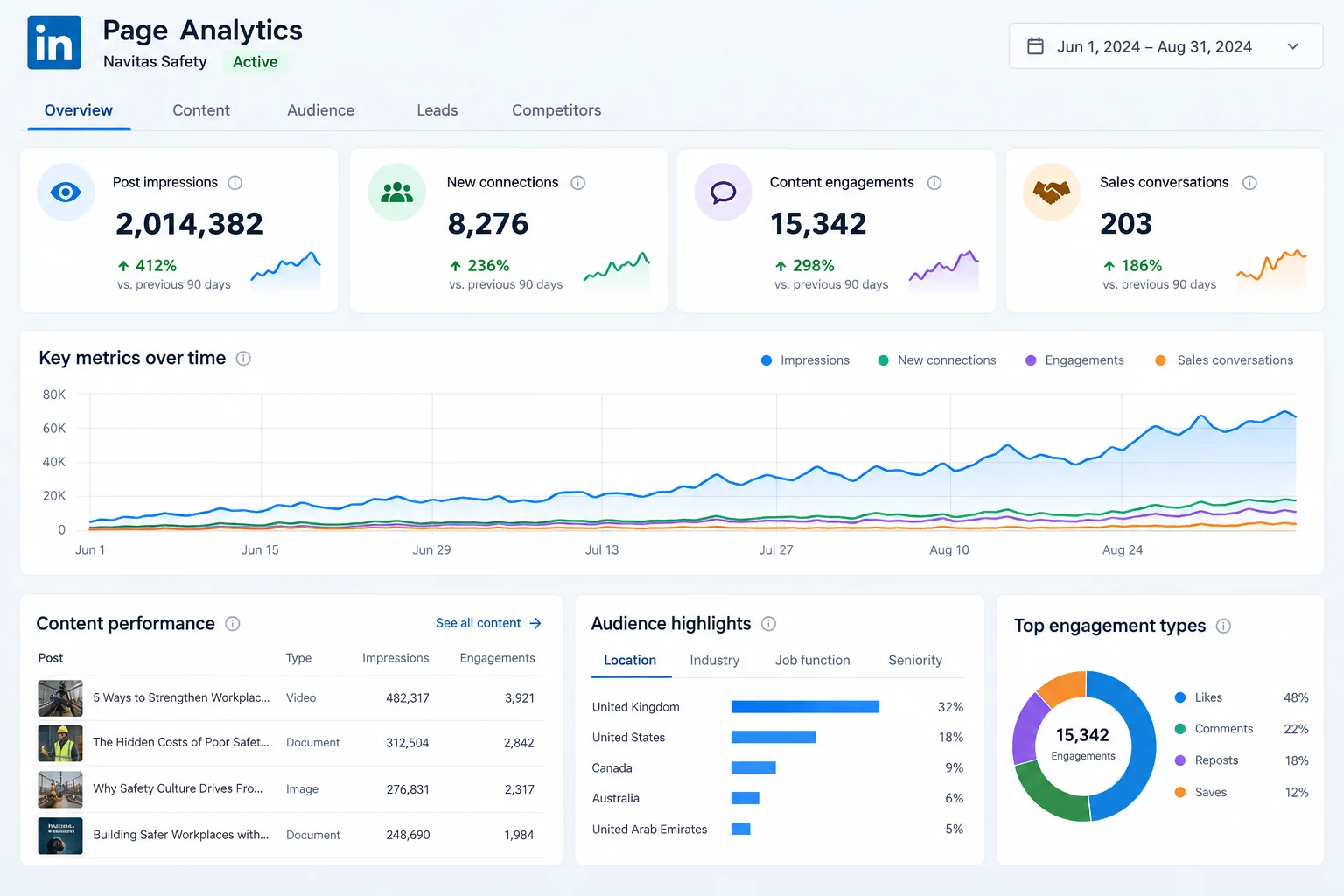
Content ran on three LinkedIn accounts for Navitas Safety: the founder Ben Gardner, Head of Revenue Narcis Lungu, and Derek Gardner, founder of the European Safety Bureau. The figures are from the company’s LinkedIn analytics for that period.
 123
Muneeb built my LinkedIn and my sales team’s profiles from scratch. Within a few months we were having conversations we never had before.
Ben GardnerFounder, Navitas SafetyWhat carries over to your team
Where to start
The pilot runs the full programme for a small group, with a fixed price and a fixed end date. It ends with a report on the conversations each person started, and a decision that is yours to make.
Employee Content pilot
Fixed price agreed on the call
Asked of each person
Interview45 minutes a monthApprovals and commentsA few minutes a dayWhat happens during the pilot
The content policy and approval rules are agreed with leadership. Each person has a short onboarding call, and the first interview is recorded.
Each person approves their first drafts in Slack. Posts go out from their own accounts, and each person starts commenting on target accounts from a daily list.
Posts go out every working day, with the daily comment list and message sorting. A second interview refreshes the idea bank.
A written report sets out reach, conversations and meetings for each person, with the posts that started them.
Questions
About 45 minutes a month for the interview, and a few minutes a day to approve drafts in Slack and send the comments prepared for them. Nobody is asked to write. A person who is busy on a given day can skip their drafts and nothing is published.
A content policy is agreed with leadership in week one. It sets the subjects each person covers, the claims that need sign-off and what is never posted, such as customer names or figures under embargo. Every post is then approved by the account owner. A second approver from marketing or legal can be added before drafts reach the employee.
The account belongs to the employee, so it leaves with them. Their scheduled posts stop on the day you tell us. The interview recordings, idea bank and voice guides belong to the company, and their place on the programme can pass to another person.
Each conversation that starts from a post, comment or message is logged in your CRM with the person and the post that started it. The monthly report shows conversations and meetings for each person, alongside reach and profile visits from target accounts.
No. Posts are scheduled through a tool that each person connects with their own permission and can disconnect at any time. Each person approves every post and sends their own comments. Messages are handled with the access each person chooses to grant, and anything sensitive is passed to them.
No. Advocacy tools ask employees to reshare company posts. Here each person publishes original posts under their own name, written from their own words in the interview.
Next step
Free, on video. Send the names and roles of the people you have in mind, and the call is spent on a post angle for each of them and a pilot plan.
Analytics cookies
This site uses Google Analytics and PostHog to count visits and see how pages are used, including session recordings with typed text masked. No advertising. Privacy policy
 Fieldline / Interviews / November · Near-miss reporting
 Slack / Drafts for approval
 Fieldline / Employee Content / Week of 16 November