Short answer
Post from personal profiles to start conversations, and keep the company page for jobs, ads, product news and proof. In Metricool's 2026 study of 673,658 LinkedIn posts, personal profiles averaged a 2.60% engagement rate against 1.60% for company pages, while impressions per post were similar. People also trust peers more than CEOs: in Edelman's 2024 survey, 74% trusted someone like them to tell the truth about new technology, against 51% for CEOs. Most B2B teams need both accounts, with people doing most of the talking.
On this page
The LinkedIn company page vs personal profile question comes up when page reach falls and someone asks whether the team should post instead. Public data points one way: posts from people earn a higher engagement rate, and people trust peers more than CEOs. The company page still has a job, and the table below shows which posts belong on it.
LinkedIn company page vs personal profile: people get more engagement per post
Personal profiles get a higher engagement rate than company pages, but about the same number of impressions per post. The gain from posting as a person shows up in reactions, comments and conversations, with views about level.
The largest recent dataset comes from Metricool, which analysed 673,658 posts from 63,108 accounts for its 2026 LinkedIn study. Personal profiles reached a 2.60% engagement rate against 1.60% for company pages, while both account types got a similar number of impressions per post. Metricool sells social media tools, gives only a short method summary and does not say how it calculates engagement rate. Read the gap as a direction and expect your own numbers to differ.
The same study found a split on links. On company pages, posts with links got 51% more impressions than average. On personal profiles, link posts got 27% fewer impressions. In practice, put links on the page and keep employee posts self-contained.
LinkedIn’s feed now ranks posts by what they are about
In March 2026 LinkedIn said its feed now reads the topic of each post and matches it to each member’s interests. It also said it is reducing engagement bait and repetitive posts. The announcement does not mention company pages, but specific posts from people with real experience fit what it describes.
In its 12 March 2026 announcement, LinkedIn said its new systems “better understand what a post is actually about.” It is also working to “reduce repetitive, low‑substance posts and engagement bait,” and to “make engagement pods ineffective and curb comment automation or third party tools.”
For employee posts, this rules out pods and automated comments. LinkedIn says members will see more posts with “genuine insight, actionable ideas, and thoughtful perspectives.” An engineer explaining a problem they solved last week fits that description.
People trust “someone like me” more than CEOs
People trust peers and technical experts more than CEOs to tell the truth about new technology. A company page speaks with the voice of the institution, while an employee speaks as a person with a job and a name.
In the 2024 Edelman Trust Barometer (page 10), 74% of respondents trusted “someone like me” to tell the truth about new innovations and technologies, the same as scientists. A company technical expert scored 66%, and CEOs scored 51%. The survey covered more than 32,000 people in 28 countries, with fieldwork in November 2023. This question went to half the sample, and the figures are a 26-market average.
The question covered the general public and new technology, so it says nothing direct about B2B buyers. It supports posting from practitioners. No public study was found that measures how much more an employee’s post is trusted than the same post from a page.
The “8x engagement” and “561% reach” stats cannot be traced
Two numbers appear in many employee advocacy articles: employee content gets 8x more engagement, and brand messages reach 561% further when employees share them. No published dataset could be found for either. Leave both out, and cite the Metricool and Edelman figures above instead.
- “8x the engagement.” The earliest dated version found is a Social Media Today webinar recap published on 29 May 2014. The webinar was sponsored by SocialChorus, an employee advocacy software company, and one of its co-founders opened the session. The recap says “content shared by employees receives 8x the engagement of content shared on brand channels,” with no source given for the figure.
- “561% further.” This appears on an MSL UK article about employee advocacy with an asterisk, and the page gives no footnote, source or method for it. Later articles repeat it without a method. One February 2026 article rewords it as personal profiles getting 561% more reach than company pages, which is a different claim, and names no source.
If either number appears in a pitch deck, ask for the dataset behind it.
LinkedIn now sells reach through people’s posts
LinkedIn lets companies pay to promote posts written by people, and reports much higher click-through for those ads than for standard image ads. It also said it would retire its built-in employee advocacy tools in November 2024, so the posting process is yours to run.
Thought Leader Ads let a company sponsor posts by its employees, executives and other members who approve. LinkedIn reports “a 252% increase in CTR compared to conventional single image ads,” based on its own 2025 data. The figure is LinkedIn’s own and unaudited.
In October 2024, DSMN8 reported that LinkedIn had decided to sunset its Employee Advocacy analytics, the My Company tab and the Curator admin role in November 2024. DSMN8 sells employee advocacy software, so it has an interest in the story. Teams that want employees posting now need their own process.
Keep jobs, ads and product news on the company page
The company page is the home base. It holds jobs, ads, product news, events and links to proof, and buyers visit it to check you are real. Opinions, lessons and how-to posts belong on the profiles of the people who did the work.
| Content type | Post from | Why |
|---|---|---|
| Job openings and hiring news | Page, shared by the hiring manager | Jobs live on the page; the manager adds the human reason to join |
| Product releases and links to docs | Page | Link posts do better on pages than on profiles |
| Events and webinars | Page | One official place for dates and sign-up links |
| Customer case studies | Both | Page carries the link; the account lead tells the story |
| Lessons from customer work | Person | Specific experience is what the feed and buyers reward |
| Opinions on your market | Person | An opinion needs a name behind it |
| How-to and technical explainers | Person | The expert who did it is the trusted voice |
Keep the page’s About text the same as the one-line description on your website. The guide to getting mentioned in ChatGPT answers explains why a company described the same way everywhere is easier for AI assistants to repeat.
Both: page first, then people
The page posts the announcement with the link, since link posts do better on pages. People who built it post what changed for customers, in their own words and without the link in the post.
Page for the facts, people for the reason it matters.
Both: the job on the page, the story from the manager
The role lives on the page and its jobs tab. The hiring manager posts about the team, the work and the kind of person who would enjoy it.
Candidates read the manager to decide whether to apply.
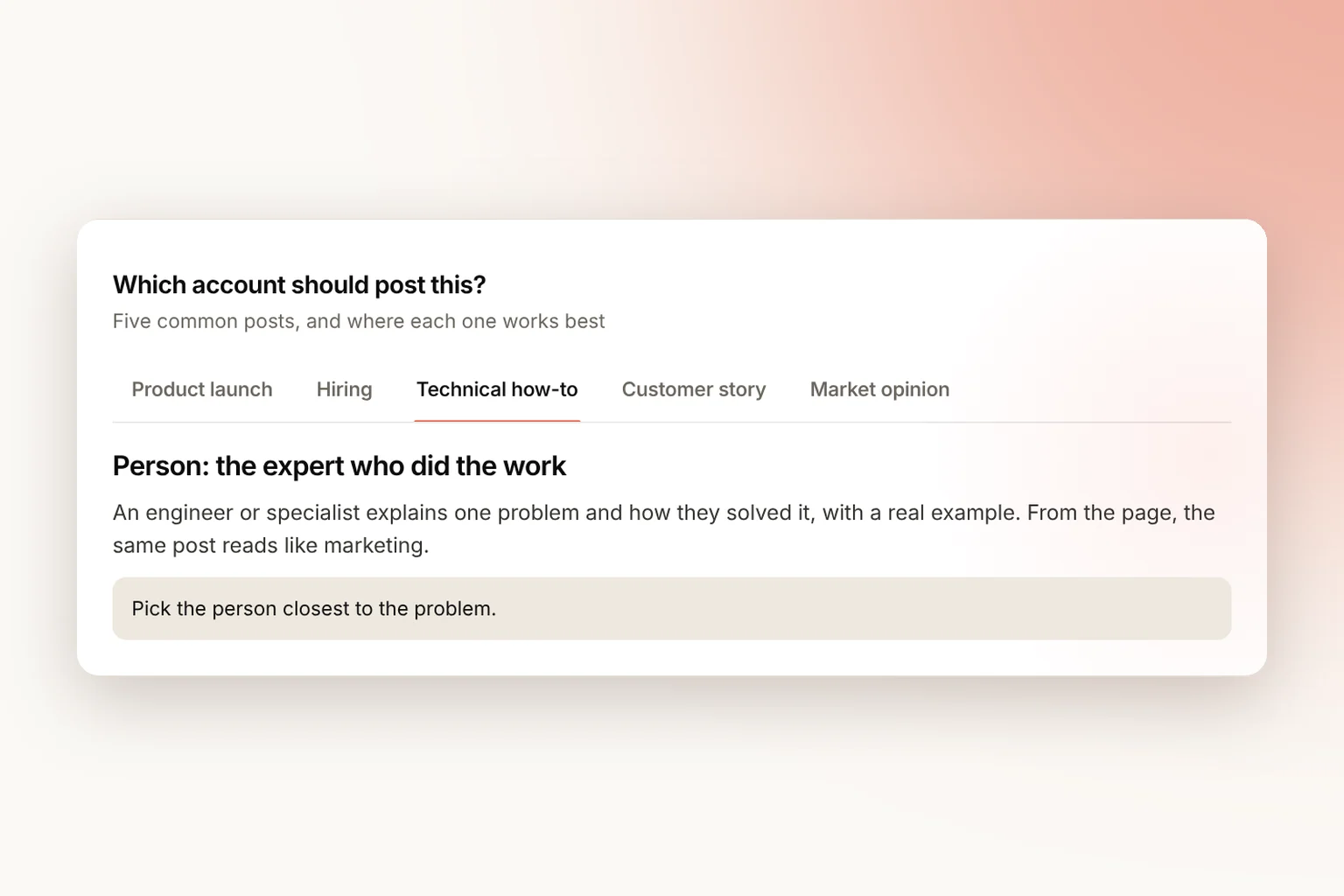
Person: the expert who did the work
An engineer or specialist explains one problem and how they solved it, with a real example. From the page, the same post reads like marketing.
Pick the person closest to the problem.
Both: case study on the page, story from the account lead
The page links to the full case study. The person who ran the account tells one moment from it: the problem, the fix and what the customer said.
Clear the customer name before anyone posts.
Person: opinions need a name
A view on where your market is going belongs to a founder or a senior practitioner who will answer the replies. From a page it sounds like a press release.
The person who posts it should reply to every serious comment.
To run this across a team, see how Employee Content turns one monthly interview into posts for each person. If only the founder will post, Founder LinkedIn and the guide to LinkedIn ghostwriting for founders cover that case.
X works for B2B only with Premium and the right audience
On X, accounts without Premium now get very little reach. Premium accounts get about ten times the median reach of regular ones. Use X only for the one or two people whose buyers are clearly there, and pay for Premium.
Buffer’s analysis of 18.8 million posts from 71,000 X accounts between August 2024 and August 2025 found that Premium users got around 10x the median reach of regular accounts. Regular accounts’ median engagement rate fell to 0% by March 2025, and their link posts had a median engagement rate of 0%.
The audience is also smaller. Pew’s 2026 survey found that 31% of US adults say they ever use LinkedIn, against 18% for X. For most B2B teams, LinkedIn is the default and X is the exception for developer, AI, fintech and investor audiences.
Sources
- LinkedIn Trends: 2026 study (673,658 posts) · Metricool
- How LinkedIn is improving the feed to show more relevant, authentic professional content · LinkedIn, 12 March 2026
- 2024 Edelman Trust Barometer Global Report (page 10) · Edelman
- From employee to advocate: mobilize your team to share your brand content (earliest dated use of the 8x figure found) · Social Media Today, 29 May 2014
- Employee advocacy: the modern day BBQ sell? (unsourced use of the 561% figure) · MSL UK
- LinkedIn engagement down 50%: Algorithm Insights Report 2025 (reworded 561% figure, no source) · WrittenlyHub, 12 February 2026
- Thought Leader Ads · LinkedIn Marketing Solutions
- LinkedIn discontinues employee advocacy analytics · DSMN8, 8 October 2024
- Does X Premium really boost your reach? An analysis of 18M+ posts · Buffer, 2 October 2025
- Social Media Fact Sheet · Pew Research Center, updated 19 October 2026
Questions
Should we stop posting on our LinkedIn company page?
No. Keep posting jobs, product news, events and links to case studies there, because buyers check the page to see that you are real and LinkedIn ads run from it. Move opinions, lessons and how-to posts to the people who did the work.
Why did our company page reach drop?
LinkedIn does not publish reach benchmarks for pages, so no outside source can tell you why one page dropped. In March 2026 LinkedIn said its feed now reads what each post is about and is reducing engagement bait and repetitive, low-substance posts. The announcement does not mention pages, so compare impressions per post before and after March 2026 in your Page analytics.
Do employee posts help the company page grow?
They can send readers to the page, but no current public study measures how much. Mention the company where it is relevant, and keep the page complete with jobs, proof and a clear description, so readers who click through find what they need.
Is X worth it for B2B company accounts?
Only when your buyers are active there. Buffer's 2025 analysis of 18.8 million X posts found that regular accounts' median engagement rate fell to 0% by March 2025, and Premium accounts got about 10 times the median reach. Pew's 2026 survey found 18% of US adults use X, against 31% for LinkedIn.

Founder of Autoniqo. Runs LinkedIn, outbound and AI search for founder-led B2B teams in the US, UK, EU and the Gulf. 405 projects on Upwork at 100% Job Success.