Short answer
LinkedIn ghostwriting for founders means a writer creates posts in the founder's voice from regular interviews, and the founder approves them before they go out. Writing-only services start around $1,500 a month; programmes that add strategy, engagement and lead follow-up commonly run $3,000 to $5,000 a month. Judge it by conversations with buyers, not likes.
On this page
Founders know LinkedIn works for their peers. Few have the hours to write three good posts a week. Ghostwriting fills that gap, but quality varies widely, and so does price. This guide covers both. If your team will post as well, see what belongs on the LinkedIn company page and what on personal profiles.
A ghostwriter turns the founder’s thinking into posts
Good ghostwriting starts with the founder, not the writer. The writer interviews the founder, captures stories, opinions and the words buyers use, and turns them into posts the founder approves. The posts sound like the founder because the ideas are the founder’s.
Poor ghostwriting starts with a topic list and a template. It reads like everyone else’s feed, and buyers can tell.
Most founders pay $1,500 to $5,000 a month
Prices depend on volume and on how much of the work beyond writing is included. Published guides put writing-only freelancers at $1,500 to $2,500 a month for 8 to 12 posts, and operator-style programmes at $3,000 to $4,500 for 12 to 20 posts with strategy and reporting (Death to Cold Emails). RevBoss publishes $3,500 a month for its core programme and $4,500 and up for a fuller one (RevBoss).
Free in cash, expensive in time
You keep full control of the voice. The cost is three to eight hours a week, and posting usually stops when the business gets busy.
Works for founders who enjoy writing and protect the time for it.
Low cost, more editing
A tool drafts from your prompts for a small monthly fee. The drafts need heavy editing to sound like you, and the tool has no strategy or follow-up.
Works as a helper for founders who already write.
About $1,500 to $2,500 a month for writing
A writer interviews you and drafts 8 to 12 posts a month. Strategy, engagement and lead follow-up are usually not included.
Works when someone in your team handles comments and DMs.
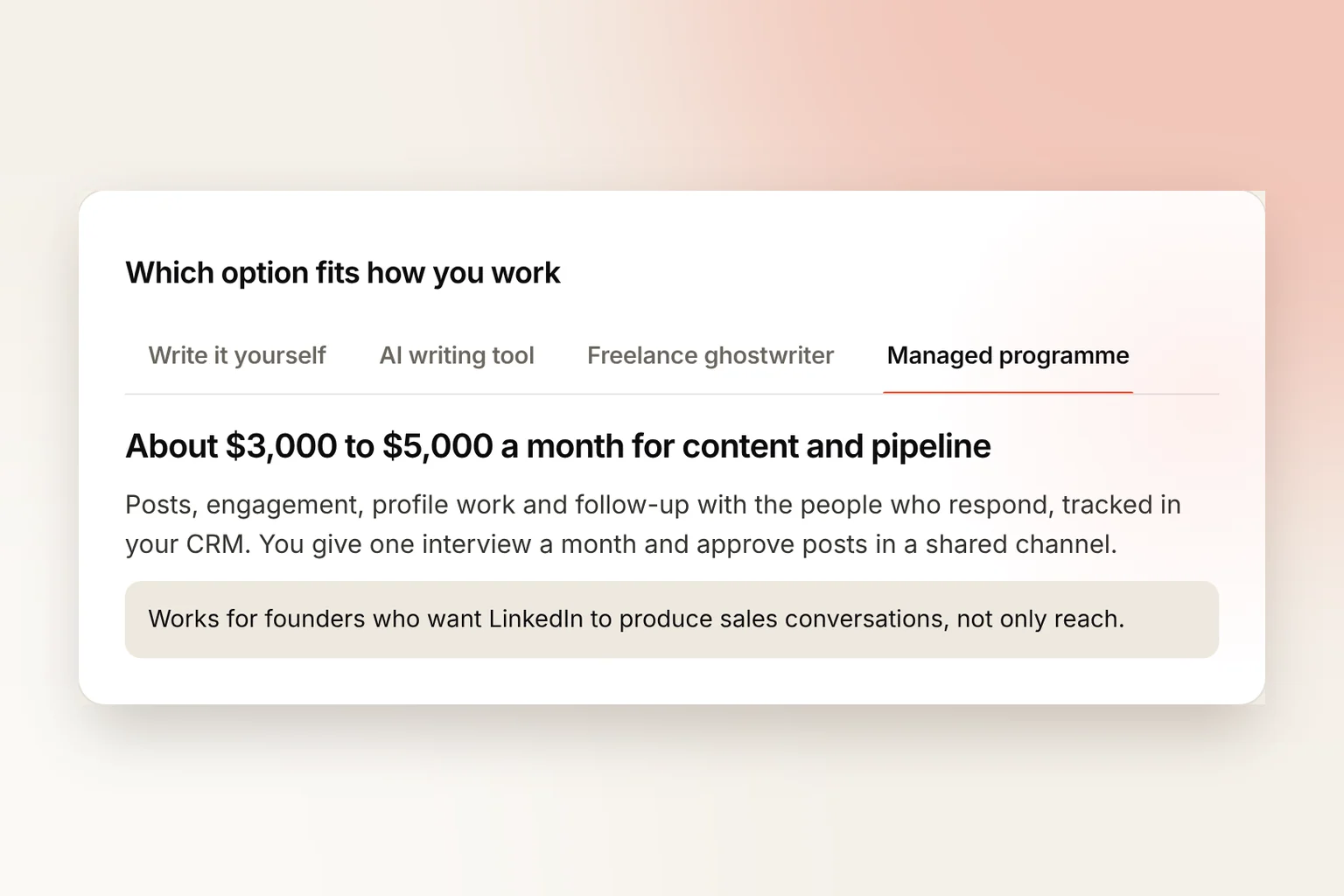
About $3,000 to $5,000 a month for content and pipeline
Posts, engagement, profile work and follow-up with the people who respond, tracked in your CRM. You give a short call each week, or one longer interview a month, and approve posts in a shared channel.
Works for founders who want LinkedIn to produce sales conversations, not only reach.
A good process protects the founder’s time
The best processes ask little of the founder. One longer interview a month, or a short call each week, produces the raw material. A weekly call keeps posts current with deals, customers and news. Drafts arrive in a shared channel such as Slack, where the founder approves or edits in minutes. Someone handles engagement and follow-up, and the results show up in the CRM.
- Call
A short weekly call on stories, opinions and customer questions
- Drafts
Posts written in the founder's voice
- Approve
Founder approves or edits in Slack
- Engage
Comments answered, relevant posts joined
- Follow up
Buyers who engage get a direct, personal message
- Track
Conversations logged in the CRM
Know what the first month looks like
A good programme spends the first month building the base, so the posts sound like you from the start.
- Week 1: interview and profile. A recorded interview about your story, your opinions and the questions customers ask. The profile, banner and featured section are updated to match.
- Week 2: voice and topics. A short voice guide and a list of topics drawn from the interview, approved by you.
- Week 3: first posts. The first drafts arrive for approval. Expect to edit more now than later, while the writer learns how you speak.
- Week 4: rhythm. Posting runs on a fixed schedule, and engagement and follow-up with buyers begin.
Brief a ghostwriter well
The quality of the posts depends on the quality of the input. Give the writer:
- Your customer in one sentence, and the titles you want reading your posts.
- Three opinions you hold that people in your field would disagree with.
- Five stories: a customer win, a mistake you made, how the company started, a hard decision, a moment that changed how you work.
- Words you never use, and phrases that sound like you.
- Links to posts you admire, with a line on what you like about each.
Turn one interview into a month of posts
Founders are far better at talking about their work than writing about it. In conversation they give examples, tell stories and say what they actually think, and those are the parts that make a post worth reading. One good interview usually holds more ideas than a month needs. The transcript is broken into moments, and each moment becomes a post.
| Moment in the interview | Post it becomes |
|---|---|
| A story about a lost deal | What the deal taught you about your buyers |
| A strong opinion about your category | A short point of view with one example |
| A number you mentioned in passing | A post built around that number and what it means |
| A mistake your team made early on | A lesson post, with what you would do now |
| A question customers always ask | A plain answer, written for the buyer |
Unused moments go into an idea bank, so no week starts from a blank page.
Keep the voice yours
The voice is the part founders worry about most. Generic ghostwritten posts are easy to spot because they use phrases the founder would never say. A few rules keep the voice right:
- Use your exact phrases. If you say “customers” and never “clients”, the posts do too.
- Keep your opinions as strong as you said them. Don’t soften them into something safe.
- Leave out filler openings. Start with the point, the way you would in a meeting.
- Keep a voice file. Every edit you make goes into a short list of do’s and don’ts, so the same fix never has to be made twice.
The first month has the most edits. By the third month, most drafts should need a word changed here and there, or nothing.
Measure conversations, not likes
Likes and impressions show reach. They do not show whether buyers are paying attention. Track three things each month instead:
- Profile visits from your target titles. LinkedIn shows who viewed your profile; count the ones who fit your customer profile.
- Inbound messages and connection requests from buyers. These are the first sign the content is reaching the right people.
- Sales conversations started from LinkedIn. Log them in the CRM with LinkedIn as the source.
If impressions rise and these three stay flat, the posts are reaching the wrong audience. Change the topics before you change the volume.
Spot the signs that it is not working
Three signs mean the programme needs to change. The posts read like anyone could have written them. Engagement comes from other writers and creators instead of buyers. No sales conversations have started from LinkedIn after three months of steady posting.
When any of these appear, go back to the interview. Most fixes come from better raw material: sharper opinions, more specific stories and clearer words about the buyer’s problem.
Ask a ghostwriter these questions before you sign
- “How do you capture my voice, and how much of my time does it take?”
- “Who handles comments and messages, and how fast?”
- “Which results do you report, and from which system?”
- “Can I see posts you wrote for a founder in a similar field, with their permission?”
Sources
- LinkedIn ghostwriting for B2B: 2026 pricing by operating model · Death to Cold Emails
- Top LinkedIn agencies 2026 (published RevBoss pricing) · RevBoss
Questions
Is it acceptable for a founder to use a ghostwriter on LinkedIn?
Yes, as long as the ideas, stories and opinions are the founder's own and the founder approves every post. The writer shapes the founder's thinking into posts; they do not invent it.
How much time does LinkedIn ghostwriting take from the founder?
A good process needs either one longer interview a month or a short call each week, plus a few minutes to approve posts. A weekly call keeps posts tied to what happened that week. Replies to comments and DMs work best when the founder handles or approves them.
How long before LinkedIn ghostwriting produces leads?
Expect two to three months of steady posting before inbound conversations become regular. Pairing posts with direct outreach to a named list shortens that.

Founder of Autoniqo. Runs LinkedIn, outbound and AI search for founder-led B2B teams in the US, UK, EU and the Gulf. 405 projects on Upwork at 100% Job Success.