Short answer
Founder-led sales works when the founder sells to a short, named list of accounts, starts conversations through LinkedIn and personal email, runs discovery calls that test the problem before pitching, and records every win and loss in a CRM. Aim for steady weekly conversations rather than big launches. By about 20 customers, the notes should be good enough to hand the process to a first sales hire.
On this page
Founders sell better than anyone else in the early days. They know the product, can change the offer on the call and can make promises a seller cannot. The aim of founder-led sales is to use that advantage to find a process that someone else can repeat.
Sell to a short, named list, not a market
Start with 100 to 300 named accounts that match your first customer profile. Name the person at each one you want to talk to. A short list lets you research each account and follow up properly.
Rank the list by how likely the account is to have the problem right now. Recent funding, new hires in the buyer’s team, a new regulation or a competitor switching are all reasons to move an account to the top.
Start conversations through LinkedIn and personal email
Founders get replies that sellers do not. Use that. Send short, personal notes from your own inbox and LinkedIn account, mentioning something specific about the buyer’s situation.
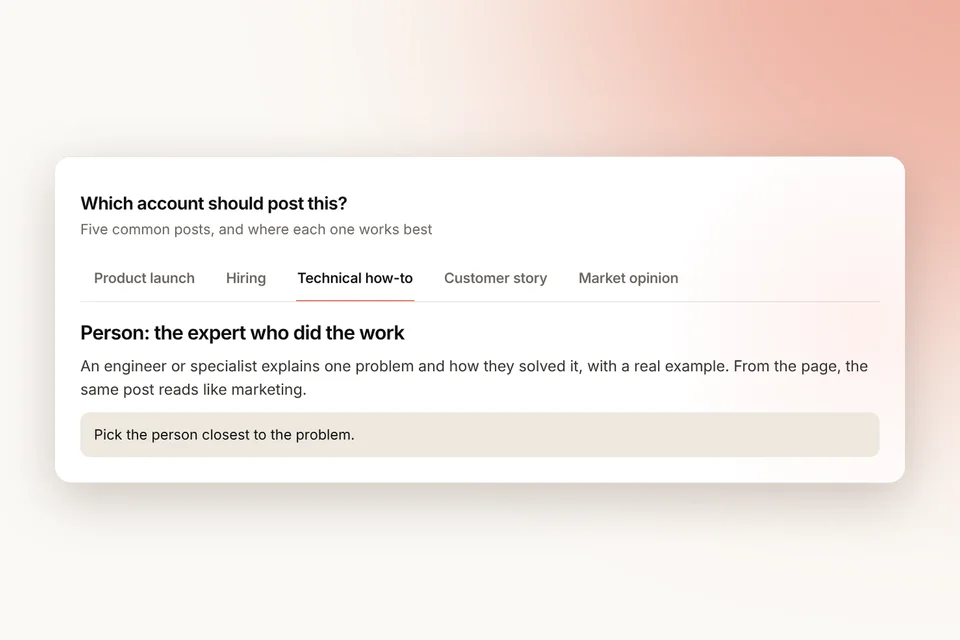
Post on LinkedIn at the same time. Buyers often look at your profile before they reply. When they see recent, useful posts about their problem, the cold message reads as a conversation with someone who knows the field. Post from your own profile: personal profiles get more engagement per post than company pages.
Write opening messages that sound like you
Founders get replies because the message comes from the person who built the company. Keep it short, specific and plain. Three patterns work well as starting points.
The observation. “Saw you opened a second site in Leeds. Most operators we talk to find compliance records get harder to keep once there are two kitchens. Is that something you’re dealing with?”
The question. “Quick one: how are you tracking supplier certificates across your sites today? We built a tool for this and I’m talking to operators about how they handle it.”
The useful note. “We pulled together the five audit findings that come up most in multi-site kitchens. Happy to send it over if it’s useful, no strings.”
Rewrite each one in your own words and for your own buyer. A message that sounds copied gets ignored.
Use discovery calls to test the problem before you pitch
The first call is for learning, not presenting. Ask what the buyer does about the problem today, what it costs them and who else is involved in fixing it. Pitch only once you know the answer is worth solving.
End every call with a clear next step and a date. “Let’s stay in touch” is not a next step.
Run discovery calls in five parts
A simple structure keeps first calls focused on learning. It also gives you notes you can compare across calls.
- Set the agenda (2 minutes). Say how long the call will take, what you want to learn and that you will share what you do if it seems useful.
- Ask about the problem (10 minutes). “How do you handle this today?” “What did it cost you last quarter?” “Who else is involved when it goes wrong?”
- Ask about past attempts (5 minutes). “What have you tried?” “Why did that not stick?” The answer tells you what you are competing with.
- Show only what matters (5 to 10 minutes). Connect one or two parts of your product to the problem they described. Skip the rest.
- Agree a next step with a date (3 minutes). A follow-up call, a pilot, an introduction to the person who signs. Put it in the calendar before you hang up.
Run the playbook in four phases
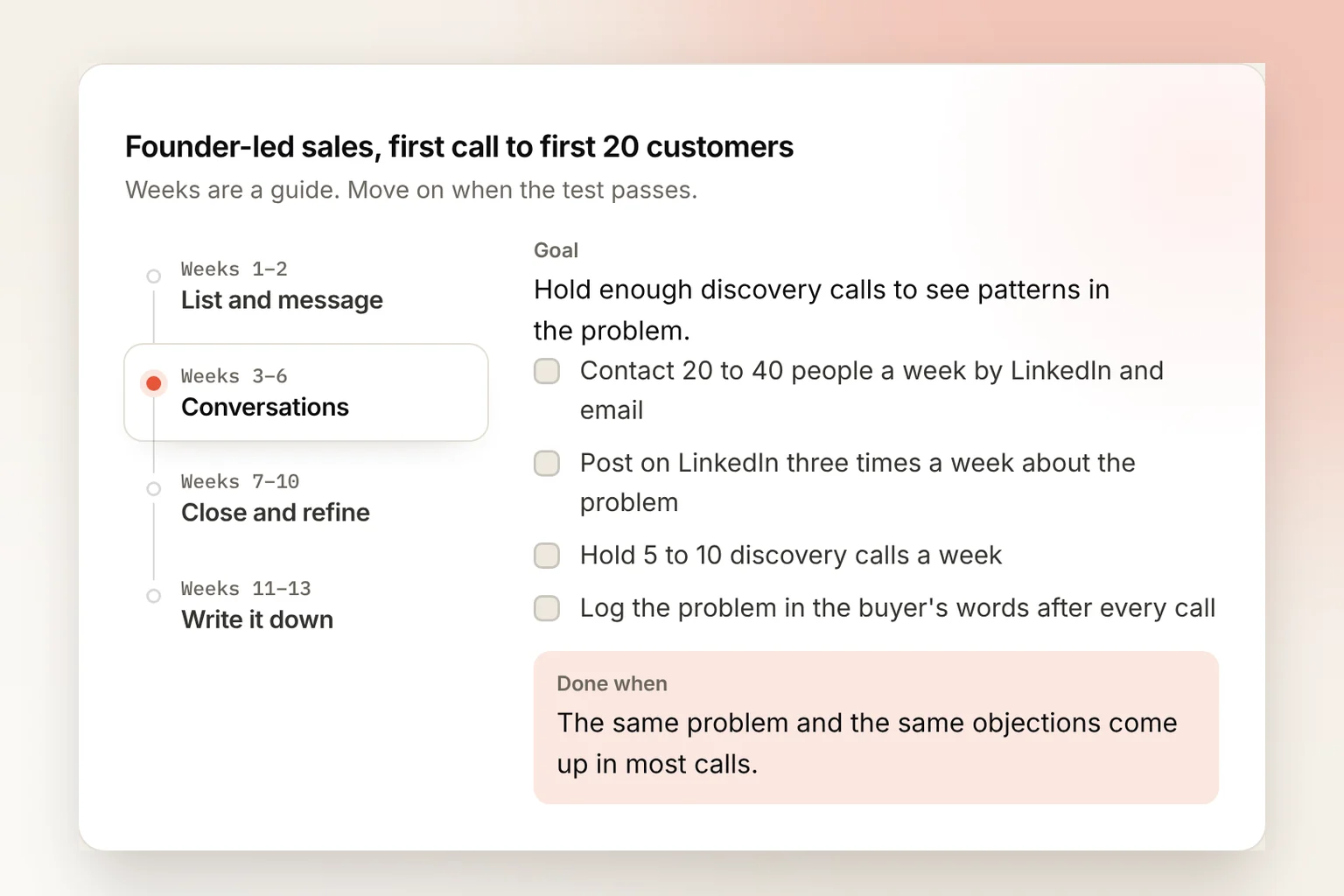
The phases below take a founder from the first list to a process someone else can run. Each phase has a test before you move on.
GoalBuild the first named list and write messages that sound like you.
- Pick 100 to 300 accounts that fit one profile
- Name the buyer at each account
- Write three short opening messages and one follow-up
- Set up a CRM with five stages
Done whenYou can start ten personal conversations a day without rewriting the message each time.
GoalHold enough discovery calls to see patterns in the problem.
- Contact 20 to 40 people a week by LinkedIn and email
- Post on LinkedIn three times a week about the problem
- Hold 5 to 10 discovery calls a week
- Log the problem in the buyer's words after every call
Done whenThe same problem and the same objections come up in most calls.
GoalTurn the strongest conversations into paying customers.
- Send proposals within 48 hours of a good call
- Offer a low-risk first step, such as a pilot
- Review every lost deal and write down why
- Adjust the price and the offer once, not weekly
Done whenDeals close for the same reasons, and you can predict which ones will.
GoalTurn what works into a playbook for the first hire or partner.
- Write the ICP, the pitch and the objection answers
- Save your best emails, posts and call notes
- Record two discovery calls, with permission, for training
- Decide whether to hire or bring in a partner
Done whenSomeone else could start conversations and run first calls from your notes.
Avoid the mistakes that slow founder-led sales
- Pitching on the first call. Buyers share less once they feel sold to. Learn first, show later.
- Saying yes to every custom request. Early deals with heavy customisation feel like wins but teach you little about the repeatable product.
- Letting follow-ups slip. Most deals at this stage are lost to silence, not to a competitor. Send the follow-up the same day.
- Keeping notes in your head. If it is not in the CRM, your first hire cannot learn from it.
Record every win and loss in the CRM
The value of founder-led sales is what you learn. Log every deal, its stage and the reason it moved or stopped. A loss reason written the same day is worth far more than a memory three months later.
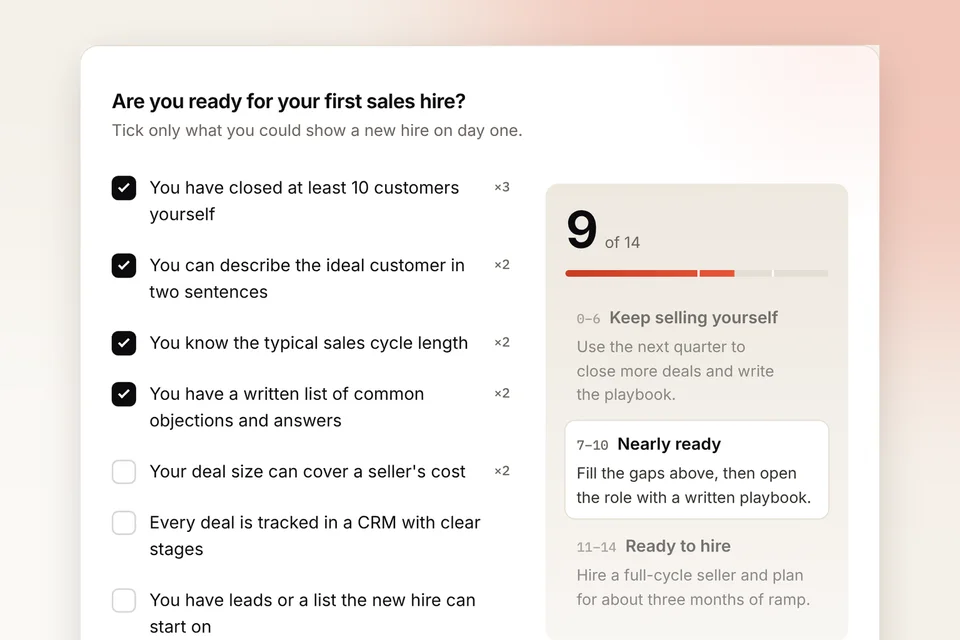
First Round Capital suggests founders should be able to answer three questions before the first sales hire: the ideal customer, the typical sales cycle and the common objections with their answers (First Round Review). Your CRM notes are where those answers come from.
Hand over when the process repeats
SaaStr suggests founders close roughly 10 to 20 customers before hiring the first account executive (SaaStr). By then you should know who buys, why, and how long it takes. That is the moment to hand the work to a hire or a partner, with your notes as their playbook.
Sources
- The first sales hire (0 to $5M) · First Round Review
- Dear SaaStr: When Should I Hire My First AE? · SaaStr
Questions
How much time should a founder spend on sales?
In the first year, often half the week or more. Block fixed time for outreach and calls, because sales work slips first when product work gets busy.
Should a founder post on LinkedIn while selling?
Yes. Posts warm up the same people you are contacting directly. Buyers often check the founder's profile before replying, so recent, useful posts raise reply rates.
What should a founder track in founder-led sales?
Conversations started, discovery calls held, opportunities created, deals won and the reason for every loss. Keep it in a CRM from the first deal.

Founder of Autoniqo. Runs LinkedIn, outbound and AI search for founder-led B2B teams in the US, UK, EU and the Gulf. 405 projects on Upwork at 100% Job Success.