Short answer
A go-to-market strategy for a startup is five decisions: the customer you sell to first, the problem you lead with, the offer and price, the one channel you reach buyers through, and how deals close. Make each decision on paper in the first two weeks, run one channel at full effort for a month, then keep what produced meetings and drop the rest. Ninety days is enough to know whether the motion repeats.
On this page
Most early-stage startups do not lack effort. They lack a short list of decisions that everyone works from. A go-to-market (GTM) strategy is that list. It is written in a page, tested in a quarter and rewritten when the numbers say so.
A go-to-market strategy is five decisions you can test
A useful GTM strategy answers five questions in plain language. MarketerHire’s definition lists the same core parts: the ideal customer profile, positioning, pricing, channels and the team that executes (MarketerHire). Each decision below has a test, so you know when it is wrong.
| Decision | What you write down | How you know it is wrong |
|---|---|---|
| First customer | One company type, size and buyer title | Fewer than 1 in 10 conversations turn into a real next step |
| Problem | The one problem you lead with, in the buyer’s words | Buyers agree it exists but do not rank it in their top three |
| Offer and price | What they get, what it costs, how they start | Interest disappears when price comes up |
| Channel | The one place you reach buyers first | Two months of steady effort, no meetings |
| Motion | Founder-led, sales-led or self-serve | Deals stall at the same step every time |
Write the answers before you spend money. A founder who cannot fill the table in one sitting is not ready to hire for sales or marketing yet.
Pick the first customer narrower than feels comfortable
Your first customer profile should be small enough that you can name 200 to 500 companies that fit it. “B2B SaaS companies” is not a profile. “UK food businesses with 3 to 20 sites and a compliance manager” is.
A narrow profile does three jobs at once. It tells you which list to build, which words to use and which proof matters. It also makes every later number easier to read, because you are comparing like with like.
Lead with one problem the buyer already pays to solve
Buyers respond to problems they already spend money or time on. Find them on calls: ask what the buyer did about the problem last quarter and what it cost. If the answer is “nothing”, it is not a problem they will pay you to fix this year.
Write the problem in the buyer’s own words. Those words become your subject lines, your LinkedIn posts and the first sentence of every page on your site.
Run one channel at full effort before adding a second
The first channel should be where your buyers already are. For most founder-led B2B startups that is LinkedIn and targeted outbound email, because both reach a named list of people. Content and search come next, once you know which questions buyers ask.
Full effort means a real volume. For outbound, that is a few hundred well-chosen accounts a month with a sequence you rewrite every two weeks. For LinkedIn, it is three or more posts a week from the founder, with replies to comments the same day. Personal profiles get a higher engagement rate than company pages, so post from people rather than the company page.
Use the first 90 days to prove the motion repeats
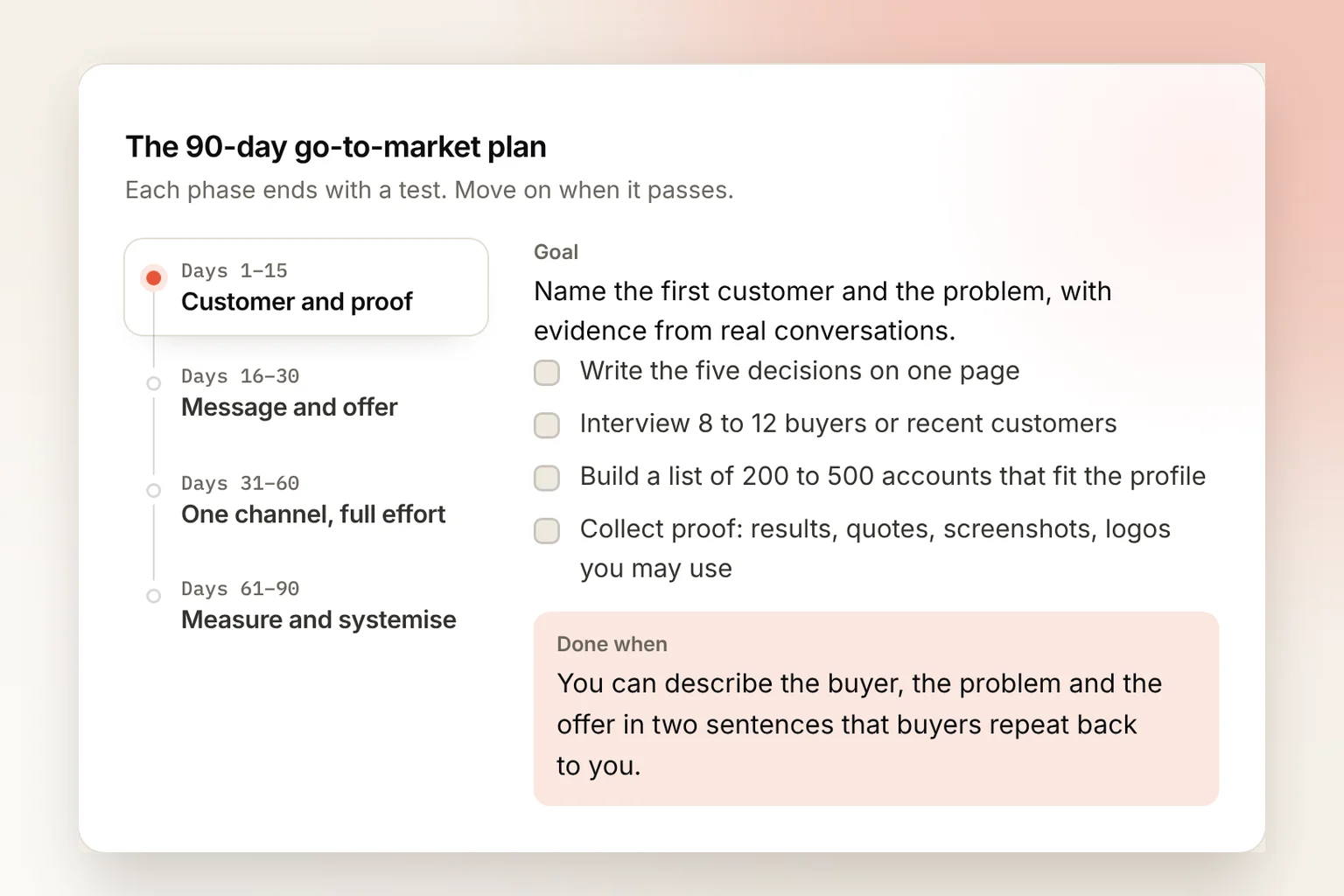
The plan below is the one used on early-stage engagements. Each phase ends with a test, so you move on when the evidence says so, not when the calendar does.
GoalName the first customer and the problem, with evidence from real conversations.
- Write the five decisions on one page
- Interview 8 to 12 buyers or recent customers
- Build a list of 200 to 500 accounts that fit the profile
- Collect proof: results, quotes, screenshots, logos you may use
Done whenYou can describe the buyer, the problem and the offer in two sentences that buyers repeat back to you.
GoalTurn the problem into a message and an offer a buyer can say yes to quickly.
- Write the one-sentence positioning and the first-call pitch
- Set a starting price and a low-risk first step
- Draft the first outbound sequence and 8 LinkedIn posts
- Set up the CRM pipeline stages and tracking
Done whenThe message gets replies from the right titles in a test of 50 to 100 accounts.
GoalRun the chosen channel at a real volume and log every outcome.
- Send to the full list in weekly batches
- Post on LinkedIn three or more times a week
- Rewrite the weakest sequence step every two weeks
- Review every lost deal within 48 hours
Done whenMeetings arrive every week from the same profile and the same message.
GoalKeep what produced meetings, cut what did not, and write the playbook.
- Compare reply, meeting and win rates by segment
- Drop the weakest segment and message
- Document the ICP, pitch, objections and sequence
- Decide the next hire or the second channel
Done whenSomeone other than the founder could run the motion from the written playbook.
Track four numbers, not twenty
Early on, four numbers tell you almost everything. Track them weekly in your CRM, not in a slide.
- Reply rate by segment. Low replies mean the list or the problem is wrong.
- Meetings held per week. This is the output of the whole top of the funnel.
- Meeting-to-opportunity rate. Low here means the offer or the pitch is off.
- Days from first meeting to close. This sets your cash plan and your hiring date.
Avoid the five mistakes that waste the first quarter
Most failed launches do not fail on effort. They fail on a few early choices that make every later number hard to read. These five come up again and again.
- Selling to everyone who might buy. A broad profile spreads a small budget across buyers with different problems. Nothing gets enough volume to show a pattern, so every result looks average.
- Running three channels at half effort. A little LinkedIn, a little email and a few ads each produce too little to judge. After a month you know less than you would from one channel run properly.
- Changing the message every week. A sequence needs a few hundred sends before its numbers mean anything. Rewriting it after fifty replies resets the test.
- Pricing by guesswork. Founders often price low to remove friction, then cannot afford the work needed to deliver. Set a price you can sustain, and test a smaller first step instead of a smaller price.
- Keeping the data in heads and spreadsheets. Without a CRM from day one, you cannot see why deals stall. The lessons leave when the founder gets busy.
Use a one-page plan, and fill it with evidence
The plan below fits on one page. Fill the middle column from what buyers told you, not from what you hope. The last column is the next test you will run to check each answer.
| Decision | Your answer | Evidence so far | Next test |
|---|---|---|---|
| First customer | Company type, size, buyer title | Calls held, deals won in this profile | Contact 100 more accounts that fit |
| Problem | One problem, in the buyer’s words | Quotes from calls | Lead every message with it for two weeks |
| Offer and price | What they get, what it costs, the first step | Proposals sent and accepted | Try one change to the first step |
| Channel | The one channel you run first | Replies and meetings per week | Hold volume steady for 30 days |
| Motion | Who closes and how | Days from first call to close | Hand two deals to a second closer |
Review the page with your numbers at the end of each month, and change one decision at a time so you can see what each change did. A column with no evidence after 30 days is a guess, so treat it as the next thing to test.
Know when the strategy is working
Three signs show that a go-to-market strategy is working, and all three can be read from the CRM. Meetings come from the same profile every week. The reasons buyers give for saying yes repeat. A deal can close without the founder rewriting the pitch on the call.
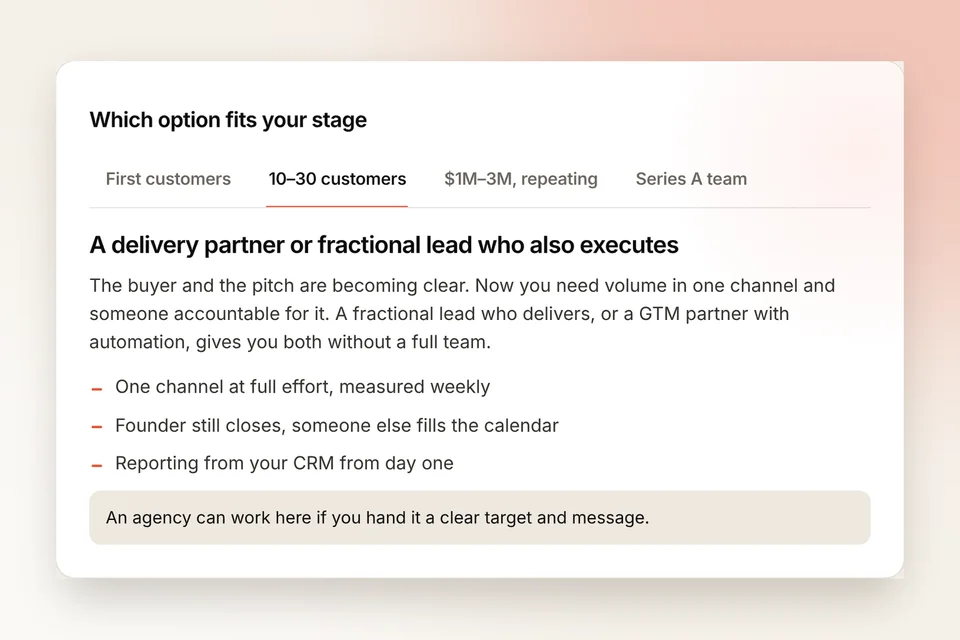
When all three hold for a month, the job changes from finding the motion to scaling it. That is the point to add a second channel, hire the first seller or bring in a partner to run the volume.
When the founder has closed enough deals to write down the buyer, the pitch and the objections, it is time to hand the motion to a hire or a partner. SaaStr puts that point at roughly 10 to 20 customers closed by the founder (SaaStr).
Sources
Questions
How long should a go-to-market strategy take to build?
The written plan takes one to two weeks. Proving it takes longer: plan on 60 to 90 days of running one channel before you judge it, because the first month mostly fixes the list and the message.
Should a startup use more than one channel at launch?
No. Pick the channel where your first customers already spend time and run it properly. Two half-run channels give you two unclear results.
What is the difference between a go-to-market strategy and a marketing plan?
A go-to-market strategy covers the whole path to revenue: who you sell to, what you sell, how you price it, how buyers find you and how deals close. A marketing plan is one part of it.
When should a founder hand go-to-market to someone else?
When the founder has closed enough deals to write down the ICP, the pitch and the common objections. SaaStr puts that point at roughly 10 to 20 customers closed by the founder.

Founder of Autoniqo. Runs LinkedIn, outbound and AI search for founder-led B2B teams in the US, UK, EU and the Gulf. 405 projects on Upwork at 100% Job Success.