Short answer
A GTM engineer builds and runs the systems behind pipeline: buying-signal tracking, data enrichment, lead scoring, routing into the CRM and automated outreach. RevOps keeps the revenue process and reporting clean; a GTM engineer builds new plays and automates them. Most startups need GTM engineering once they have a message that works and want more volume without more SDRs, often from a fractional engineer before a full-time hire.
On this page
“GTM engineer” is a new job title in B2B sales, and search interest in it climbed through 2026 on Google Trends. It is also one of the least consistent titles: some companies mean an automation builder, others mean a technical SDR. This guide sets out the version that matters to a founder.
A GTM engineer builds the system that finds and contacts buyers
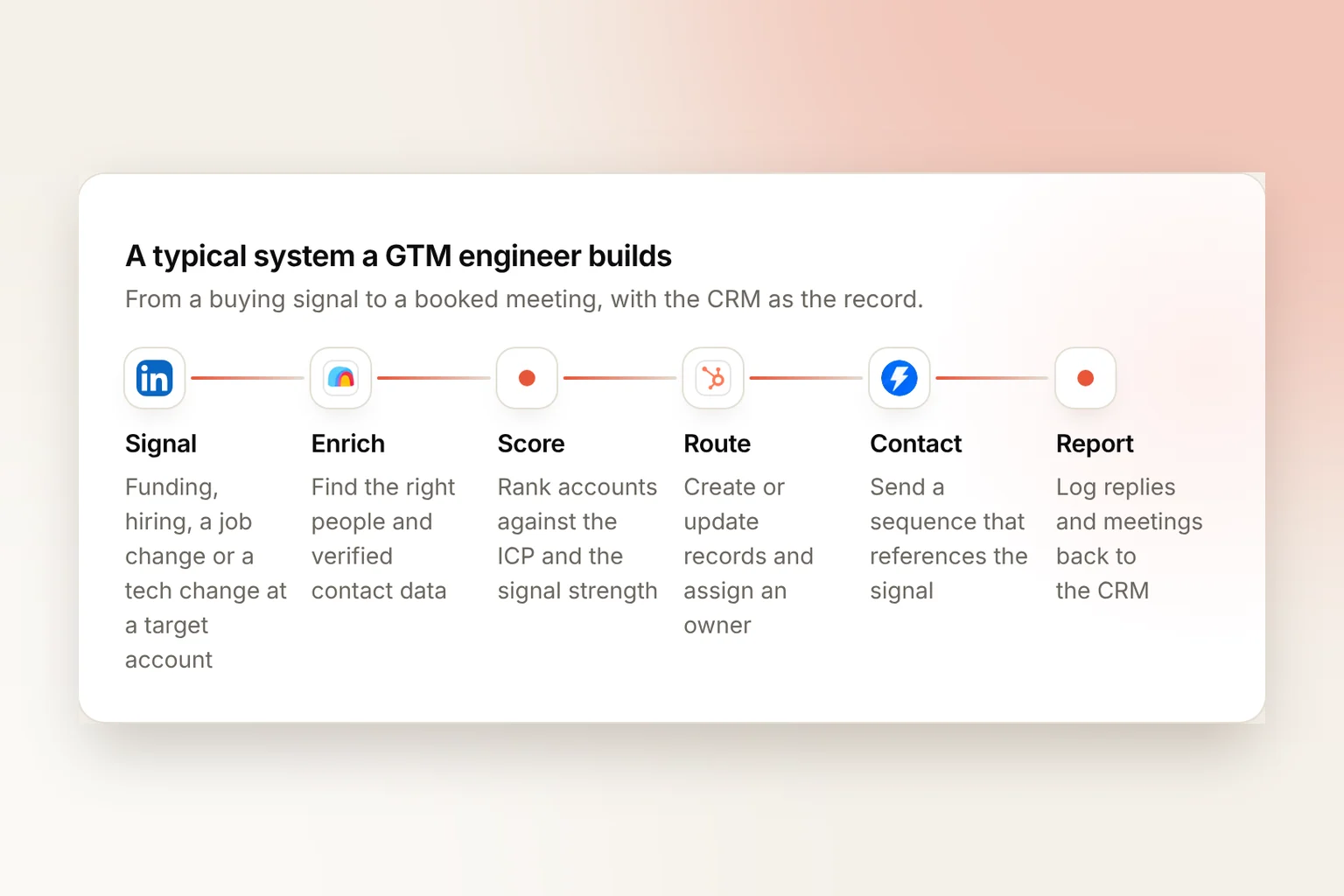
A GTM engineer turns a sales play into a system that runs every day. A founder says “we should reach companies that just raised money”. The GTM engineer builds the steps that make that happen without anyone copying names into a spreadsheet.
Apollo describes the role as designing, building and governing the revenue systems that turn GTM strategy into execution (Apollo). In practice, the system usually has six parts.
- Signal
Funding, hiring, a job change or a tech change at a target account
- Enrich
Find the right people and verified contact data
- Score
Rank accounts against the ICP and the signal strength
- Route
Create or update records and assign an owner
- Contact
Send a sequence that references the signal
- Report
Log replies and meetings back to the CRM
The role differs from RevOps, SDRs and growth marketing
The titles overlap, which is why job posts read so differently. The clearest way to separate them is by what each person owns.
| Role | Owns | Measured on |
|---|---|---|
| GTM engineer | New pipeline systems: signals, enrichment, routing, automated outreach | Pipeline from the plays they build |
| RevOps | Process, CRM data quality, forecasting and reporting | Data accuracy and forecast quality |
| SDR | Conversations with prospects and booked meetings | Meetings held |
| Growth marketer | Campaign ideas, channels and messaging | Leads and conversion |
Hiring demand still favours RevOps. In a sample of 1,046 active job posts in May 2026, Signalbase counted 825 RevOps roles and 115 GTM engineer roles, about one in eight (Signalbase).
Hire GTM engineering after the message works
Automation multiplies whatever you feed it. If the list or the message is wrong, a GTM engineer will help you send the wrong message to more people faster. Prove the message first with founder-led outreach, then automate it.
Not yet. Keep outreach manual and founder-led.
Under about 10 customers, every reply teaches you something. Automation hides those lessons. Use simple tools and a spreadsheet or basic CRM, and read every reply yourself.
A one-off project to set up the CRM and a clean list is enough.
Yes, start with a fractional GTM engineer
Replies and meetings come from one profile and message. Now the bottleneck is volume and research time. A fractional engineer can build the signal, enrichment and sequencing system in weeks and hand it to your team.
- Build the system once, document it
- Keep the founder or first AE on the calls
- Review the system monthly
Yes, hire a full-time GTM engineer
With several sellers and many plays running, someone has to own and improve the system every day. That is a full-time job, usually reporting to the head of sales or RevOps.
Expect the first months to go on data quality and routing before new plays.
Expect a working system within the first 30 days
A good GTM engineer shows results quickly, because the first system is usually small. A realistic first month looks like this.
- Week 1: audit. Review the CRM, the data sources, the sending setup and the current plays. List what is broken and what is missing.
- Week 2: clean the base. Fix duplicate records, required fields and lifecycle stages, so new data lands in the right place.
- Week 3: build one play. One signal, one enrichment flow, one sequence, one routing rule. Keep it narrow enough to measure.
- Week 4: measure and document. Compare the play’s reply and meeting rates with what the team did by hand, and write down how it runs.
Anyone who proposes ten plays in month one is likely to ship ten half-working ones. One play that runs every day without help is worth more.
Start with plays that use public buying signals
The best first plays react to something that happened at the account. The signal gives the seller a real reason to write, and it is easy to measure.
| Play | Signal | What the system does |
|---|---|---|
| Funding | The account announced a round | Finds the buyer, adds them to a sequence that references the raise |
| Hiring | The account posted a role your product supports | Finds the hiring manager, writes a first line from the job post |
| Champion move | A past user or buyer changed company | Flags the new company, alerts the account owner |
| Tech change | The account added or dropped a tool you integrate with | Adds the account to a targeted sequence |
Each play needs a clear owner on the sales side. Automation finds the account and drafts the first touch; a person still handles the replies.
Count the cost of running the system, not only building it
The build is the visible part. The running cost is what most budgets miss: tool licences, data credits, sending domains and inboxes, and the hours someone spends each week keeping data clean and fixing broken steps.
Ask for both numbers before you hire or contract anyone. A system that costs little to build but needs a day a week to keep running is a part-time job in disguise.
What to ask a GTM engineer candidate
- “Show me a system you built. What did it replace, and what did it produce?”
- “How do you keep CRM data clean when enrichment runs every day?”
- “How do you protect sending domains when outreach is automated?”
- “Which part of your last system broke first, and how did you find out?”
Good answers include the numbers before and after, and a plain description of what went wrong. Be careful with candidates who only talk about tools.
Sources
Questions
Is a GTM engineer the same as RevOps?
No. RevOps owns the process, data quality and reporting across sales and marketing. A GTM engineer builds new pipeline systems, such as signal tracking and automated outreach. In small teams one person may do both.
Does a GTM engineer need to write code?
Not always. Much of the work happens in tools like Clay, n8n and the CRM. Basic scripting and API knowledge helps, and some roles are fully technical.
What tools does a GTM engineer use?
Typical stacks include a data and enrichment tool such as Clay or Apollo, a sequencer such as Instantly or Apollo, a CRM such as HubSpot, and an automation layer such as n8n or Zapier.
Can a startup hire a fractional GTM engineer?
Yes. Fractional GTM engineers build the system and train the team, which suits startups that need the infrastructure before they need a full-time owner.

Founder of Autoniqo. Runs LinkedIn, outbound and AI search for founder-led B2B teams in the US, UK, EU and the Gulf. 405 projects on Upwork at 100% Job Success.