Short answer
A fractional CMO is a senior marketing leader who works part time for several companies. Most charge $5,000 to $15,000 a month in 2026 for about 10 to 20 hours a week. Hire one once you have early paying customers and need someone to own pipeline, and choose on three things: experience at your stage, proof of pipeline results, and a clear answer on who does the hands-on work.
On this page
Startups hire a fractional CMO to get senior marketing judgement without a full-time executive salary. It works well at the right stage and wastes money at the wrong one. This guide covers what one does, what it costs and how to choose.
A fractional CMO leads marketing part time, usually 10 to 20 hours a week
A fractional CMO does the job of a chief marketing officer for a few days a week. They set the strategy, choose channels, manage the people or vendors who execute, and report on pipeline. Most work with three to five companies at once.
The model exists because a full-time CMO is out of reach for most early-stage companies. Webtonic’s 2026 cost guide puts average total compensation for a permanent CMO at $293,575, before benefits and payroll tax (Webtonic).
Most startups pay $5,000 to $15,000 a month
Pricing depends on hours, seniority and scope. A survey of 250 fractional professionals found 29.5% charging under $5,000 a month, 40% charging $5,000 to $8,000, 18.5% charging $8,000 to $10,000 and 12% charging more than $10,000 (FRAK State of Fractional survey, summarised by Webtonic). On the Go Fractional marketplace, rates average $177 an hour for about 9 hours a week (Go Fractional).
| Model | Typical price | What you get |
|---|---|---|
| Hourly advisory | $200 to $500 an hour | Strategy sessions and reviews, no ongoing ownership |
| Monthly retainer | $5,000 to $15,000 a month | 10 to 20 hours a week, owns the plan and reports on it |
| Embedded fractional | $15,000 to $25,000 a month | About three days a week, runs the team day to day |
| Interim CMO | $25,000 to $60,000 a month | Full-time cover for a few months, usually between hires |
Retainer, embedded and interim ranges are from GTM 80/20’s 2026 guide; the hourly range is from Webtonic. Your quote will sit inside these ranges or explain why it does not.
Hire one after your first paying customers, not before
A fractional CMO helps most when there is something to scale. That means paying customers who fit a clear profile, a product they keep using, and a founder who has run enough sales calls to know the objections.
Before that point, the job is discovery: talking to buyers, rewriting the pitch, changing the price. A part-time leader cannot do that work for the founder. Hiring one too early usually produces a polished plan for a market you have not proven yet.
Ask who does the work before you sign
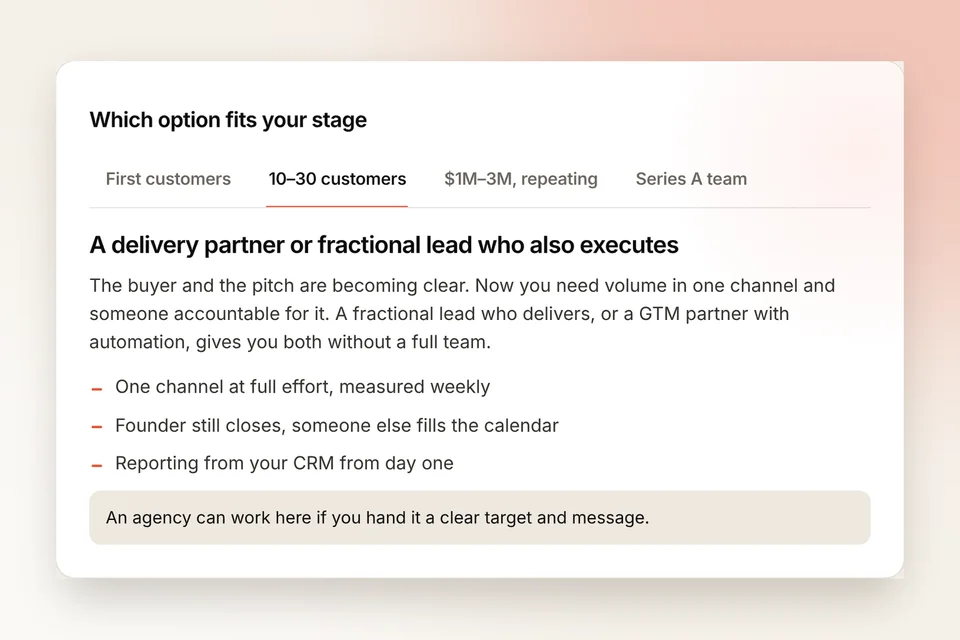
This is the question most founders skip. Most fractional CMOs set direction and manage execution, but the posts, sequences, ads, pages and reports still have to be made by someone. That someone is your team, an agency or automation, and it is usually paid for separately. The fractional CMO vs agency comparison sets the options side by side.
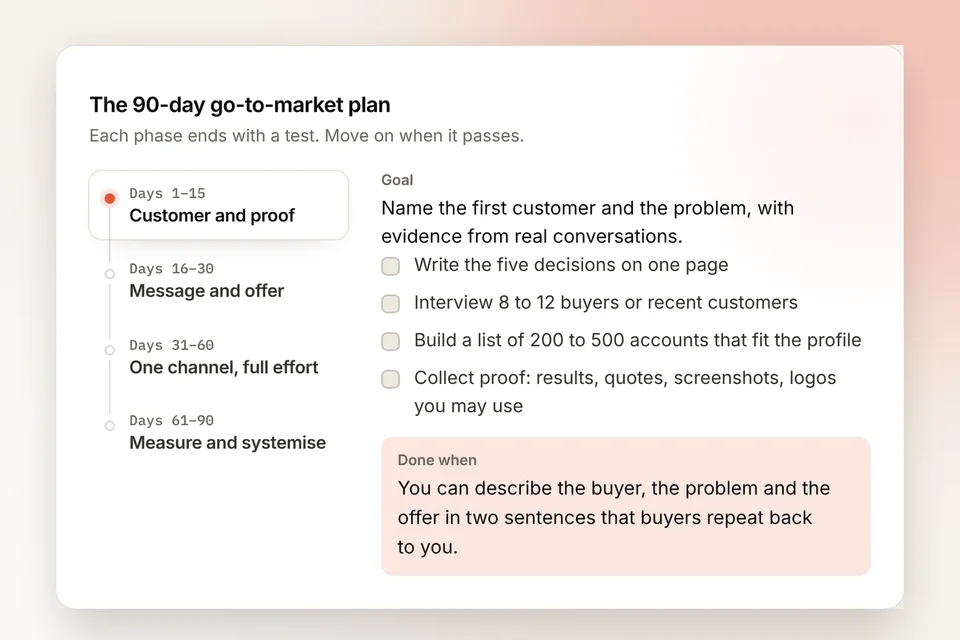
Ask each candidate to show you the delivery plan for the first 90 days: who builds what, with which tools, by when. Then add that cost to the retainer before comparing quotes. A $6,000 retainer plus a $10,000 agency is a $16,000 decision.
Score each candidate on the same checklist
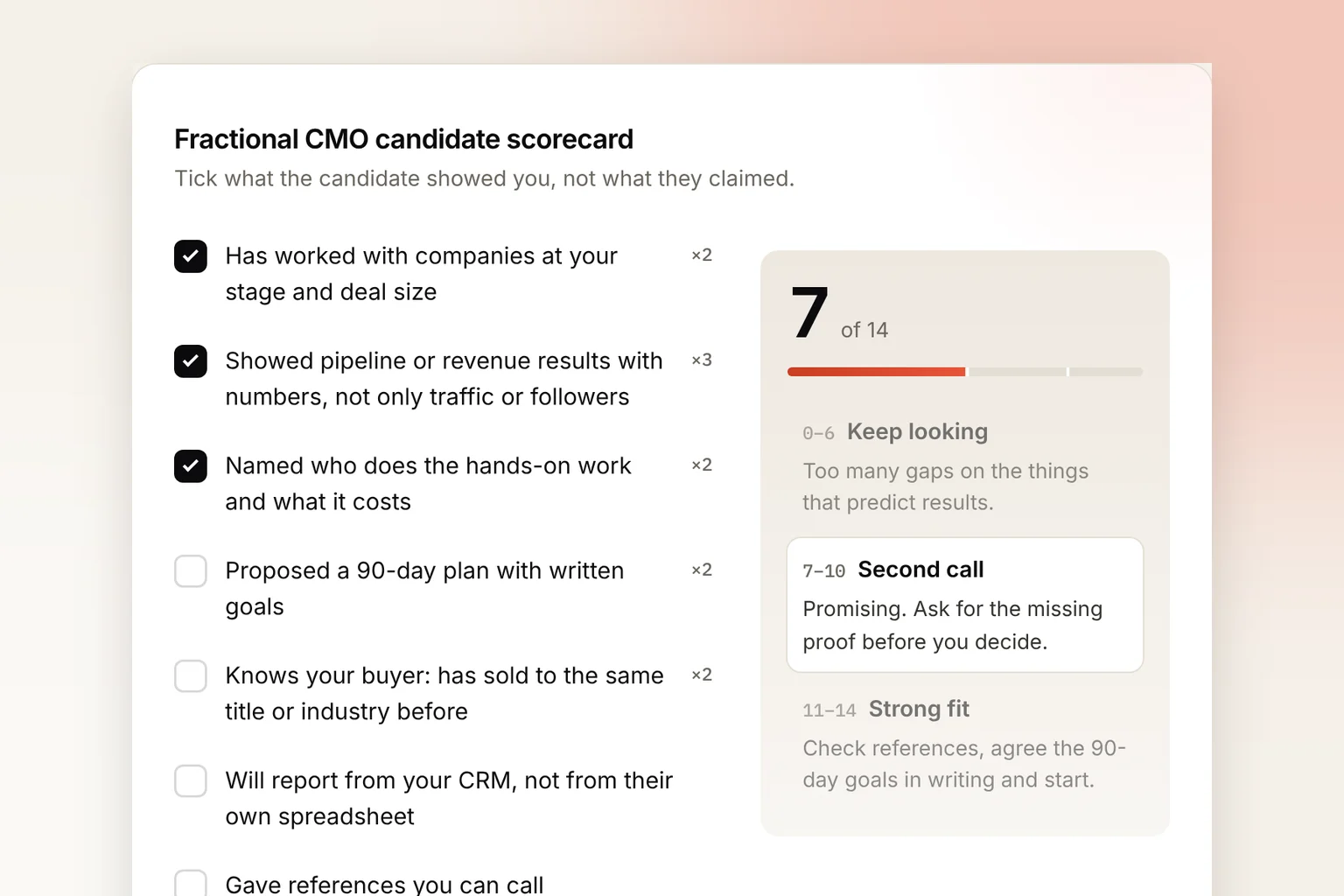
Use one checklist for every candidate and score them after the first call. The items with a higher weight are the ones that predict results; the rest are useful but secondary.
0of 14
- 0–6Keep looking
Too many gaps on the things that predict results.
- 7–10Second call
Promising. Ask for the missing proof before you decide.
- 11–14Strong fit
Check references, agree the 90-day goals in writing and start.
Ask these five questions on the first call
- “Which of your clients looked most like us, and what changed in their pipeline in the first 90 days?”
- “Who will build the campaigns, and is that inside or outside your fee?”
- “What will you need from our founder each week?”
- “Which numbers will you report, and from which system?”
- “What would make you stop the engagement early?”
Good candidates answer with names, numbers and limits. Vague answers to the first two questions are the clearest warning sign.
Expect a written plan in month one and pipeline by month three
A good fractional CMO produces visible work early. The first 90 days usually follow the same shape, and you can hold a candidate to it before you sign.
| Month | What you should see | What it proves |
|---|---|---|
| Month 1 | A written plan: target customer, message, channels, budget, the numbers to track | They understand your market and can make decisions |
| Month 2 | The first channel running at full volume, with weekly reporting from your CRM | They can get work done through people, vendors or automation |
| Month 3 | Meetings and opportunities you can trace to that channel, and a decision on what to change | The plan produces pipeline, not only activity |
If month two arrives and nothing is running yet, the engagement is drifting. Raise it at the next weekly review rather than waiting for the end of the term.
Watch for four red flags in a proposal
Proposals look alike until you read them for these four things. Any one of them is worth a direct question before you sign.
- No numbers in the goals. “Build brand awareness” cannot be checked. Ask for meetings, opportunities or pipeline value with a date.
- Execution left vague. Phrases like “coordinate with your team” often mean your team does the work. Ask who writes, builds and sends each piece.
- A long minimum term. A six-month lock-in before any results protects the provider, not you. A 90-day first term with written goals is fair to both sides.
- Reporting from their own tools. If results live in the provider’s dashboard, you lose them when the contract ends. Ask for everything to be tracked in your CRM.
Know what to do if it is not working
Most engagements that fail show it by week six. The usual causes are a target customer that is too broad, a channel that does not reach the buyer, or no one doing the hands-on work.
Do not wait for the term to end. Hold a review at day 45 with the numbers in front of you, agree one change, and set a date to check it. If the next check shows no movement, end the engagement and keep the plan, the data and the assets. Those belong to you whichever way it goes.
Sources
Questions
Is a fractional CMO worth it for a seed-stage startup?
Only if you already have paying customers and a product people use. Before that, the founder should own go-to-market, because the main job is learning from buyers, and that cannot be handed over.
What is the difference between a fractional CMO and a marketing consultant?
A consultant gives advice on a defined problem and leaves. A fractional CMO owns marketing results over time, sits in leadership meetings and manages the people or vendors who do the work.
How long should a fractional CMO engagement last?
Agree a first term of about 90 days with written goals, then continue month to month. Ninety days is long enough to run a real test and short enough to change course.
Does a fractional CMO do the execution?
Usually not. Most set strategy and manage execution, which still needs a team, an agency or automation. Ask every candidate who will do the work and what that costs on top of the retainer.

Founder of Autoniqo. Runs LinkedIn, outbound and AI search for founder-led B2B teams in the US, UK, EU and the Gulf. 405 projects on Upwork at 100% Job Success.