Short answer
Hire your first salesperson once you, the founder, have closed about 10 to 20 customers and can write down who buys, why they buy and what they object to. Make the first hire a full-cycle seller who can find and close deals, not an SDR who only books meetings, because there is no closer to hand meetings to yet. Plan on about three months before the new hire is fully productive.
On this page
The first sales hire is one of the most expensive mistakes a startup can make, because it costs both salary and months of lost momentum. Most mistakes come from hiring too early or hiring the wrong kind of seller.
Hire after you have closed 10 to 20 customers yourself
The founder should run sales until the process repeats. SaaStr’s advice is to hire the first AE once the founder has personally closed about 10 to 20 customers, and to stay involved until one or two sellers are hitting quota (SaaStr).
The reason is simple. A new seller can copy a process, but cannot invent one for you. If you have not found the process yet, the hire will spend their first months doing discovery on your payroll.
Write the playbook before the hire starts
First Round Capital suggests that before the first hire, the founder should be able to answer three questions from their own selling: who the ideal customer is, how long the sales cycle takes, and what the common objections are and how to handle them (First Round Review).
Put those answers in a short document. Add your best email, your first-call structure, the price, and notes on why your last ten deals closed or died. That document is the new hire’s first week.
Make the first hire a full-cycle seller, not an SDR
An SDR books meetings; an account executive closes them. At the first hire, the only closer is the founder. An SDR adds meetings to a calendar that is already the bottleneck.
A full-cycle seller can prospect, run the call and close. That mirrors what the founder has been doing, and it lets the founder step back from deals instead of taking more of them.
| Full-cycle seller (AE) | SDR | |
|---|---|---|
| Owns | The deal from first contact to signature | Booking meetings for someone else |
| Needs | A playbook and some leads | A closer to hand meetings to |
| Right as first hire | Yes | Rarely |
| Right as second or third hire | Sometimes | Yes, once AEs have full calendars |
Write the job description around the work, not the title
A first seller’s job is different from a seller’s job at a larger company. There is no enablement team, no steady lead flow and no proven playbook beyond your notes. Write the description so that the right people apply and the wrong ones do not.
Describe the real work: finding their own accounts for part of the week, running calls from first contact to signature, and writing down what they learn. Say plainly that the role is early and changes often. People who have only worked from a full pipeline at a large company tend to struggle in this seat, however strong their record.
Pay for results the hire can control
Commission works when the seller can influence the outcome. In the first months, much of what drives results sits with the founder: the product, the price and the leads. Set targets the hire can reach with their own effort, and review them after the first quarter.
The Bridge Group’s 2025 report shows how SDR pay is usually split: a median of about $55,000 base and $25,000 variable within $80,000 on-target earnings (The Bridge Group). Ask candidates what split they expect for a full-cycle role, and compare that with what your deals can pay for.
Plan for about three months of ramp and real turnover
A new seller takes time to reach full productivity. The Bridge Group’s 2025 survey of 351 B2B companies reports an average SDR ramp of 3.0 months and average SDR tenure of 1.9 years (The Bridge Group).
Budget for the ramp before you hire. A seller who starts in January will not be at full output until spring, so the hire has to be made before the need becomes urgent.
Check your readiness before you post the job
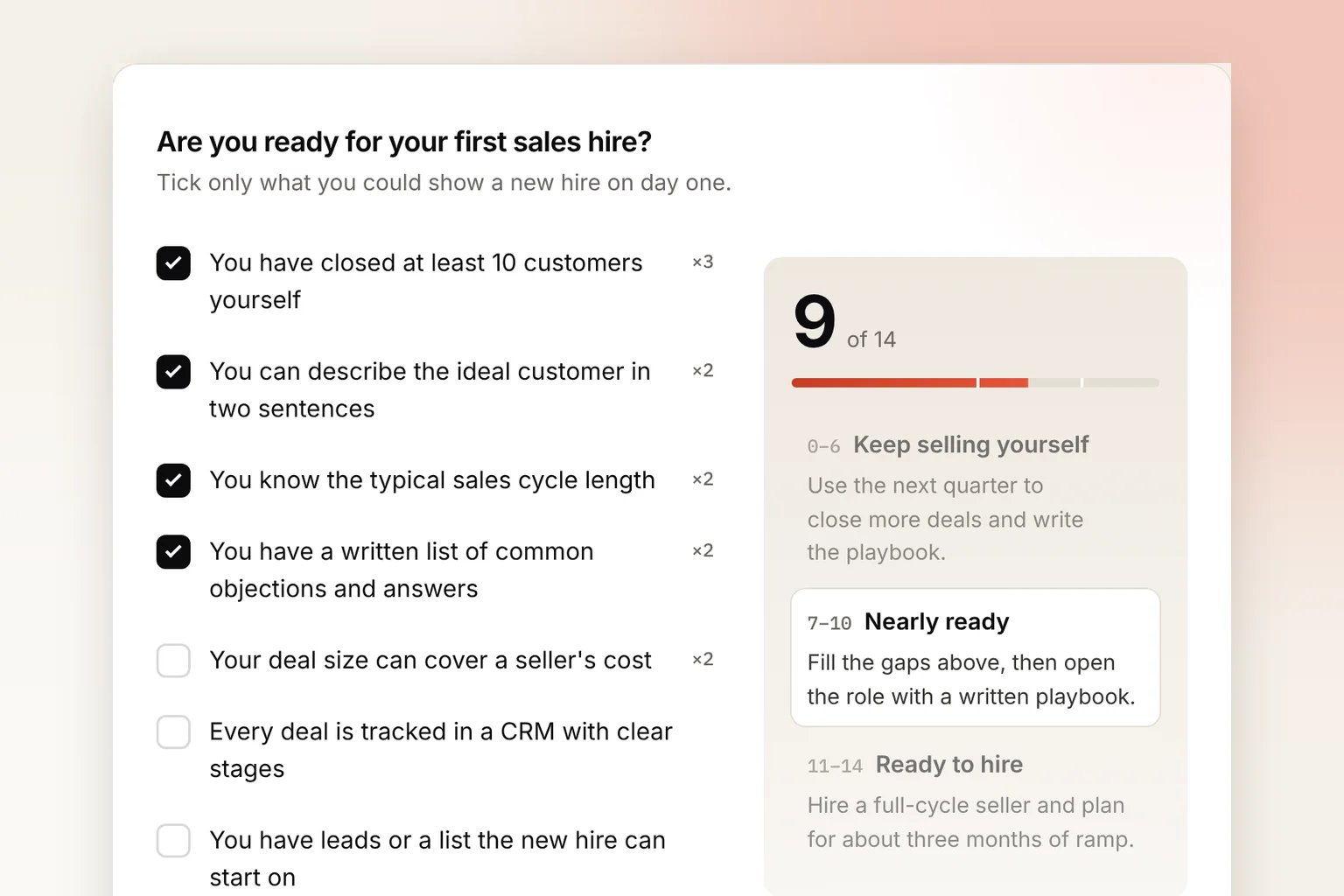
Tick what is true today. The higher-weighted items are the ones that most often cause a first hire to fail when they are missing.
0of 14
- 0–6Keep selling yourself
Use the next quarter to close more deals and write the playbook.
- 7–10Nearly ready
Fill the gaps above, then open the role with a written playbook.
- 11–14Ready to hire
Hire a full-cycle seller and plan for about three months of ramp.
Plan the first 30 days before the hire starts
- Days 1–5: learn the product and the buyer. Read the playbook, listen to recorded calls, and use the product the way a customer would.
- Days 6–15: sit in, then lead with support. Join the founder’s calls, then run calls with the founder listening.
- Days 16–30: own a set of accounts. Take a list of accounts end to end, with a weekly review of every deal.
Set one goal for the month that the hire controls, such as discovery calls held, and one learning goal, such as updating the objection list. Judge the hire on these, not on closed revenue, until the ramp is over.
Keep the founder on the biggest deals for the first quarter
Handing over sales does not mean disappearing. For the first 90 days, join the new hire’s calls on the largest deals, review every lost deal together, and update the playbook weekly. The goal is that by month four, the hire closes without you and the playbook reflects what they learned.
Sources
- Dear SaaStr: When Should I Hire My First AE? · SaaStr
- The first sales hire (0 to $5M) · First Round Review
- SDR Models, Motions & Metrics, 2025 (10th edition, 351 companies) · The Bridge Group
Questions
Should my first sales hire be an AE or an SDR?
An AE or full-cycle seller. An SDR books meetings for someone else to close. At the first hire, that someone is still the founder, so an SDR adds meetings without adding closing capacity.
How much revenue should a startup have before the first sales hire?
There is no fixed number, but many startups make the hire around $1M in annual recurring revenue or after 10 to 20 founder-closed customers. Deal size matters too: SaaStr suggests an ACV of roughly $5,000 to $10,000 can justify an AE's cost.
Should I hire one salesperson or two?
Some sales leaders recommend hiring two, so you can tell whether a miss is the person or the process. If budget allows only one, keep the founder closely involved for the first quarter.

Founder of Autoniqo. Runs LinkedIn, outbound and AI search for founder-led B2B teams in the US, UK, EU and the Gulf. 405 projects on Upwork at 100% Job Success.