Short answer
Split the store into four stages: acquire, convert, retain and measure. Check each one in that order, with one question per stage. Fix the leaks closest to revenue first, which usually means checkout, product pages and the email flows that should already be running, before you raise ad spend.
On this page
When sales stall, most stores reach for the same lever: more ad spend. Sometimes that works. Often it just sends more people into the same leaks, at a higher cost per order.
A funnel audit finds those leaks first. It treats the store as four connected stages and checks each one in turn. Here is how to run one.
Look at the funnel as four stages
Every store, whatever it sells, runs the same four stages. You acquire visitors, convert them into buyers, retain them so they buy again, and measure all of it so you know what is working.
A problem in one stage often shows up as a symptom in another. Weak retention looks like expensive acquisition. Broken tracking looks like ads that don’t work. That is why the audit covers all four, in order.
Acquire: check what each channel really returns
Start by listing every channel that brings visitors: paid social, search ads, organic search, email, affiliates and marketplaces. For each one, find two numbers: what it costs to get an order, and what those customers spend over time.
The common finding is that one or two channels carry the store, and the rest look busy without adding much. The question for this stage is simple: if you cut a channel’s budget in half, would revenue notice?
Convert: product pages and checkout
This is usually where the biggest leaks are. Baymard Institute puts the average documented cart abandonment rate at about 70%, based on dozens of studies (Baymard Institute). Some of that is normal browsing. Much of it is friction the store can remove.
Check these on a phone first, since that is where many shoppers browse:
- Is the price, including shipping, clear before checkout?
- Can someone check out as a guest?
- Are delivery times and return terms visible on the product page?
- Do product photos show scale, detail and the item in use?
- Does the page load quickly on a mobile connection?
Keep product page copy plain. Unbounce’s analysis of millions of landing page conversions found that pages written at a 5th to 7th grade reading level converted at 11.1%, against 5.3% for professional-level writing (Unbounce). Short sentences and common words help shoppers decide.
Retain: email and SMS flows that should already exist
A repeat buyer doesn’t need to be won again with ad spend. Yet many stores run only a newsletter and a basic abandoned cart email.
The core automated flows are:
- Welcome series for new subscribers, before their first order.
- Abandoned cart and browse abandonment for shoppers who drift away.
- Post-purchase to set expectations, ask for reviews and suggest the next product.
- Win-back for customers who haven’t ordered in a while.
The question for this stage: what share of last month’s revenue came from returning customers, and is it growing?
Measure: one source of truth
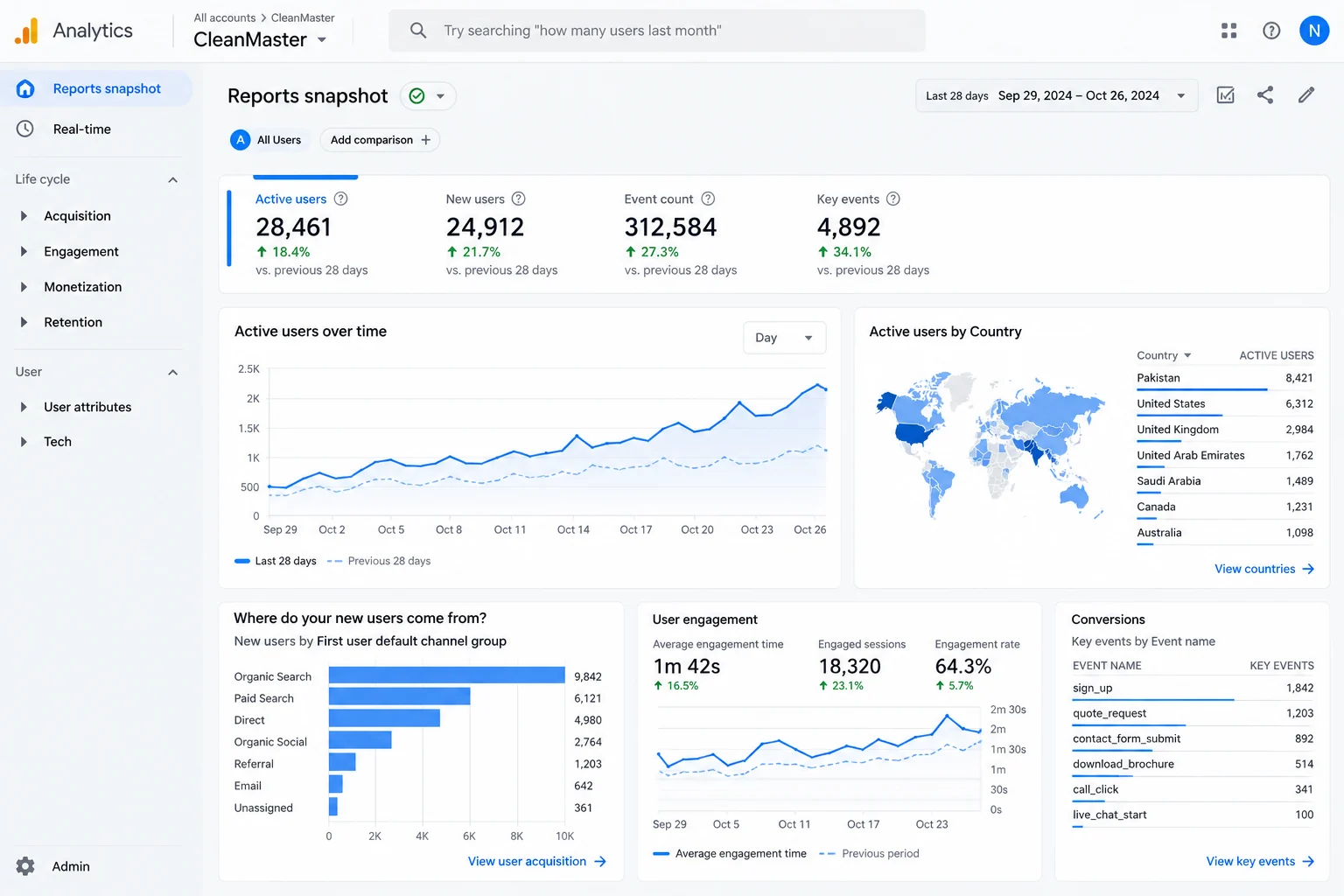
If the ad platform, the store dashboard and Google Analytics all report different numbers, decisions turn into guesswork. Each platform tends to credit itself with the sale.
Pick one place where revenue is counted, usually your store platform, and reconcile the others against it. Make sure purchase events fire correctly in GA4 and in each ad platform, and that UTM tags are consistent across campaigns and emails.
The audit checklist
Use this as a one-page summary when you run the audit.
| Stage | Question to answer | Where to look |
|---|---|---|
| Acquire | Which channels bring profitable customers, not just clicks? | Ad platforms, GA4 acquisition reports |
| Convert | Where do shoppers leave between product page and payment? | GA4 funnel report, session recordings, checkout analytics |
| Retain | How much revenue comes from repeat customers each month? | Store platform, email and SMS tool |
| Measure | Do all tools agree on orders and revenue? | Store platform vs GA4 vs ad platforms |
What to fix first
Rank every issue you find by two things: how close it sits to revenue, and how easy it is to fix. Checkout and product page fixes usually come first, because every visitor passes through them. Missing email flows come next, because they recover revenue from traffic you have already paid for.
Only then raise acquisition spend. By that point, every new visitor lands in a store that is more likely to turn them into a customer, and a customer who comes back.
Questions
What is an eCommerce funnel audit?
A structured review of every step from first ad view to repeat purchase. It finds where visitors and revenue drop off and ranks the fixes by how much money they are likely to recover.
Should I fix ads or the website first?
Usually the website and email flows. More traffic into a leaking checkout costs more and returns the same share. Fix conversion and retention first, then scale acquisition.
Which email flows should every store have?
A welcome series, an abandoned cart flow, a browse abandonment flow, a post-purchase series and a win-back flow. Together they cover the main moments a shopper drifts away.
How often should a store run this audit?
A full audit once a quarter, plus a monthly check of the key numbers for each stage. Re-run it after any big change, like a new theme, a new checkout or a new ad channel.

Founder of Autoniqo. Runs LinkedIn, outbound and AI search for founder-led B2B teams in the US, UK, EU and the Gulf. 405 projects on Upwork at 100% Job Success.